Lecture 03
January 29, 2025
…A departure from the (unachievable) ideal of complete determinism…
— Walker et al. (2003)
| Uncertainty Type | Source | Example(s) |
|---|---|---|
| Aleatory uncertainty | Randomness | Dice rolls, Instrument imprecision |
| Epistemic uncertainty | Lack of knowledge | Climate sensitivity, Premier League champion |

Probability is a language for expressing uncertainty.
The axioms of probability are straightforward:
Frequentist:
Bayesian:
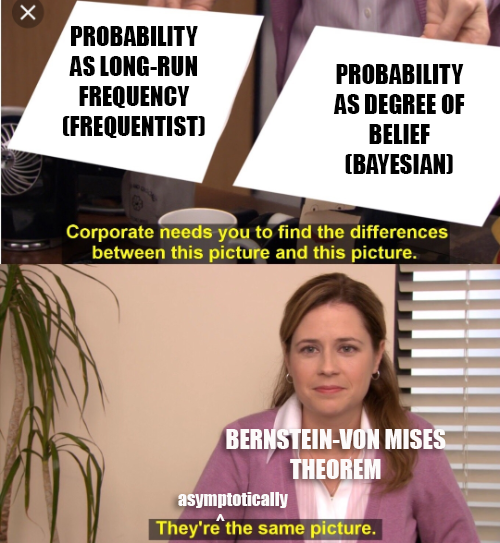
Frequentist vs. Bayesian: different interpretations with some different methods and formalisms.
We will freely borrow from each school depending on the purpose and goal of an analysis.
Distributions are mathematical representations of probabilities over a range of possible outcomes.
\[x \to \mathbb{P}_{\color{green}\mathcal{D}}[x] = p_{\color{green}\mathcal{D}}\left(x | {\color{purple}\theta}\right)\]
To write \(x\) is sampled from \(\mathcal{D}(\theta) = p(x|\theta)\): \[x \sim \mathcal{D}(\theta)\]
For example, for a normal distribution: \[x \overset{\text{i.i.d.}}{\sim} \mathcal{N}(\mu, \sigma)\]
A continuous distribution \(\mathcal{D}\) has a probability density function (PDF) \(f_\mathcal{D}(x) = p(x | \theta)\).
The probability of \(x\) occurring in an interval \((a, b)\) is \[\mathbb{P}[a \leq x \leq b] = \int_a^b f_\mathcal{D}(x)dx.\]
Important: \(\mathbb{P}(x = x^*)\) is zero!
Discrete distributions have probability mass functions (PMFs) which are defined at point values, e.g. \(p(x = x^*) \neq 0\).
If \(\mathcal{D}\) is a distribution with PDF \(f_\mathcal{D}(x)\), the cumulative density function (CDF) of \(\mathcal{D}\) is \(F_\mathcal{D}(x)\):
\[F_\mathcal{D}(x) = \int_{-\infty}^x f_\mathcal{D}(u)du.\]
Since \[F_\mathcal{D}(x) = \int_{-\infty}^x f_\mathcal{D}(u)du,\]
if \(f_\mathcal{D}\) is continuous at \(x\), the Fundamental Theorem of Calculus gives: \[f_\mathcal{D}(x) = \frac{d}{dx}F_\mathcal{D}(x).\]
The quantile function is the inverse of the CDF:
\[q(\alpha) = F^{-1}_\mathcal{D}(\alpha)\]
So \[x_0 = q(\alpha) \iff \mathbb{P}_\mathcal{D}(X < x_0) = \alpha.\]
Specifying a distribution is making an assumption about observations and any applicable constraints.
Examples: If your observations are…
Two main reasons to use linear models/normal distributions:

Source: r/GymMemes
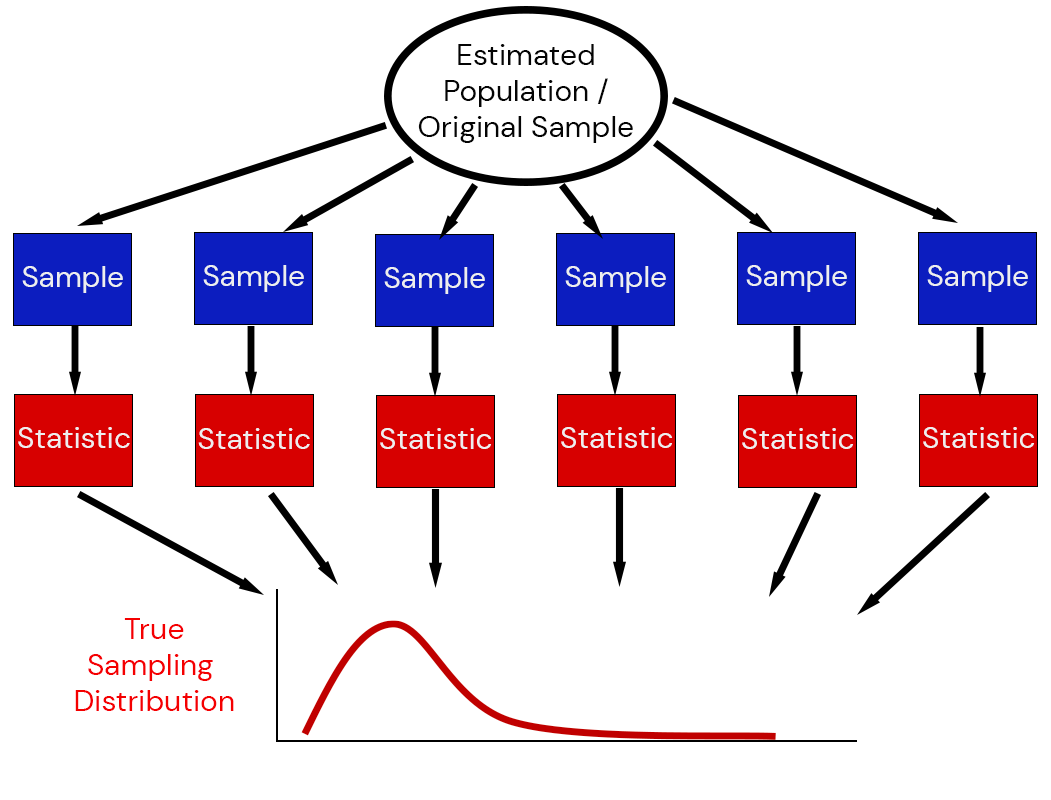
The sum or mean of a random sample is itself a random variable:
\[\bar{X}_n = \frac{1}{n}\sum_{i=1}^n X_i \sim \mathcal{D}_n\]
\(\mathcal{D}_n\): The sampling distribution of the mean (or sum, or other estimate of interest).
Illustration of the Sampling Distribution
If
\[\begin{align*} &\bbox[yellow, 10px, border:5px solid red] {\lim_{n \to \infty} \sqrt{n}(\bar{X}_n - \mu ) = \mathcal{N}(0, \sigma^2)} \\ \Rightarrow &\bbox[yellow, 10px, border:5px solid red] {\bar{X}_n \overset{\text{approx}}{\sim} \mathcal{N}(\mu, \sigma^2/n)} \end{align*}\]
For a large enough set of samples, the sampling distribution of a sum or mean of random variables is approximately a normal distribution, even if the random variables themselves are not.

Source: Unknown
There is no right answer to this, no matter what a statistical test tells you.
For example, suppose our data are counts of events:
One exploratory method to see if your data is reasonably described by a theoretical distribution is a Q-Q plot.
How do we “fit” distributions to a dataset?
Likelihood of data to have come from distribution \(f(\mathbf{x} | \theta)\):
\[\mathcal{L}(\theta | \mathbf{x}) = \underbrace{f(\mathbf{x} | \theta)}_{\text{PDF}}\]
\[f_\mathcal{D}(x) = p(x | \mu, \sigma) = \frac{1}{\sigma\sqrt{2\pi}} \exp\left(-\frac{1}{2}\left(\frac{x - \mu}{\sigma}^2\right)\right)\]
For multiple (independent) samples \(\mathbf{x} = \{x_1, \ldots, x_n\}\):
\[\mathcal{L}(\theta | \mathbf{x}) = \prod_{i=1}^n \mathcal{L}(\theta | x_i).\]
| Distribution | Likelihood |
|---|---|
| \(N(0, 1)\) | 1.9e-8 |
| Distribution | Likelihood |
|---|---|
| \(N(0, 1)\) | 1.9e-8 |
| \(N(-1, 2)\) | 1.5e-8 |
| Distribution | Likelihood |
|---|---|
| \(N(0, 1)\) | 1.9e-8 |
| \(N(-1, 2)\) | 1.5e-8 |
| \(N(-1, 1)\) | 4.6e-8 |
To find the parameters \(\hat{\theta}\) which best fit the data:
\(\hat{\theta} = \max_\theta \mathcal{L}(\theta | \mathbf{x})\)
Can use optimization algorithms to maximize \(\theta \to \mathcal{L}(\theta | x).\)
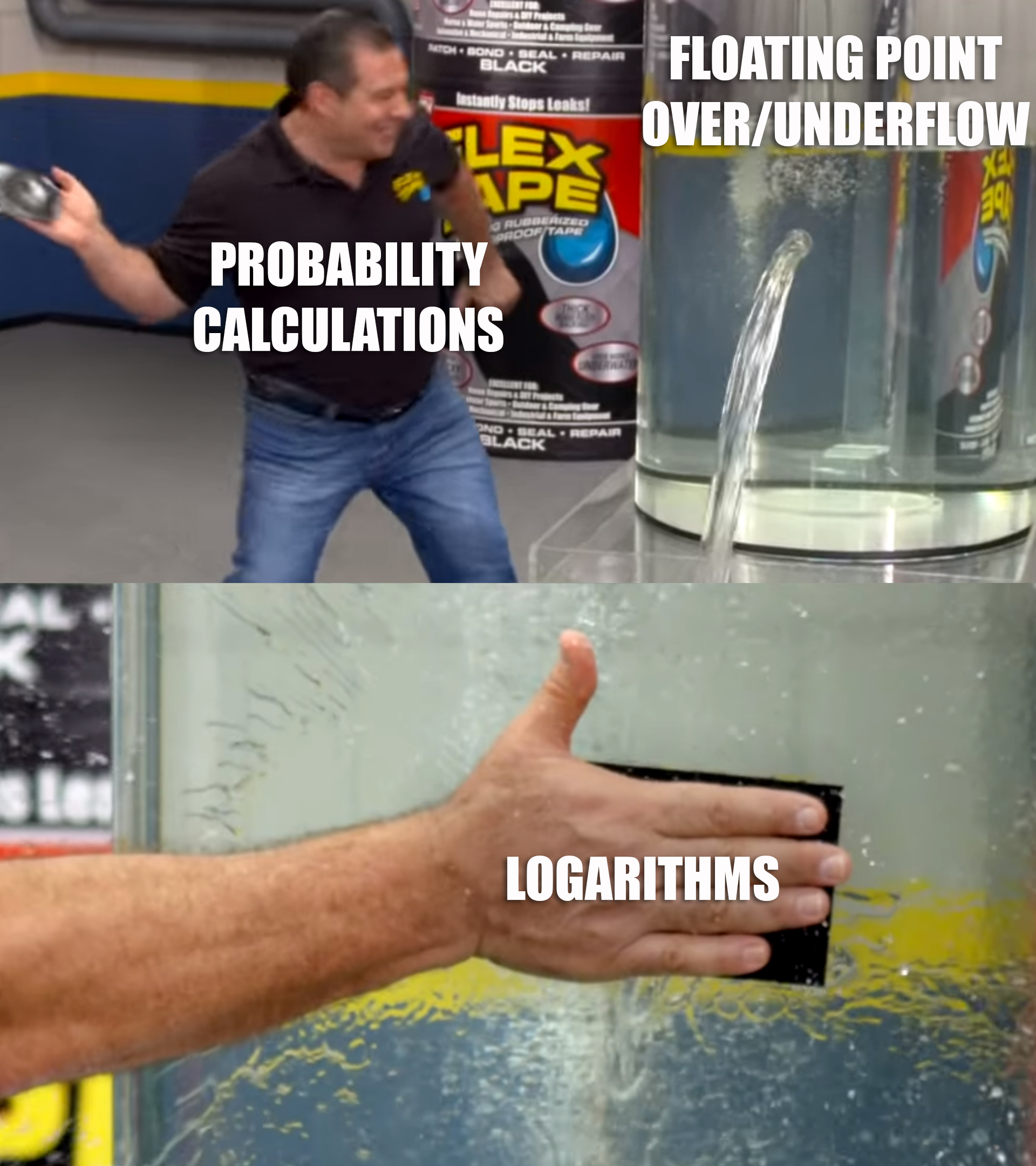
Dragons: Probability calculations tend to under- and overflow due to floating point precision.
Frequentist estimates have confidence intervals, which will contain the “true” parameter value for \(\alpha\)% of data samples.
No guarantee that an individual CI contains the true value (with any “probability”)!

# set up distribution
mean_true = 0.4
n_cis = 100 # number of CIs to compute
dist = Normal(mean_true, 2)
# use sample size of 100
samples = rand(dist, (100, n_cis))
# mapslices broadcasts over a matrix dimension, could also use a loop
sample_means = mapslices(mean, samples; dims=1)
sample_sd = mapslices(std, samples; dims=1)
mc_sd = 1.96 * sample_sd / sqrt(100)
mc_ci = zeros(n_cis, 2) # preallocate
for i = 1:n_cis
mc_ci[i, 1] = sample_means[i] - mc_sd[i]
mc_ci[i, 2] = sample_means[i] + mc_sd[i]
end
# find which CIs contain the true value
ci_true = (mc_ci[:, 1] .< mean_true) .&& (mc_ci[:, 2] .> mean_true)
# compute percentage of CIs which contain the true value
ci_frac1 = 100 * sum(ci_true) ./ n_cis
# plot CIs
p1 = plot([mc_ci[1, :]], [1, 1], linewidth=3, color=:deepskyblue, label="95% Confidence Interval", title="Sample Size 100", yticks=:false, legend=:false)
for i = 2:n_cis
if ci_true[i]
plot!(p1, [mc_ci[i, :]], [i, i], linewidth=2, color=:deepskyblue, label=:false)
else
plot!(p1, [mc_ci[i, :]], [i, i], linewidth=2, color=:red, label=:false)
end
end
vline!(p1, [mean_true], color=:black, linewidth=2, linestyle=:dash, label="True Value") # plot true value as a vertical line
xaxis!(p1, "Estimate")
plot!(p1, size=(500, 350)) # resize to fit slide
# use sample size of 1000
samples = rand(dist, (1000, n_cis))
# mapslices broadcasts over a matrix dimension, could also use a loop
sample_means = mapslices(mean, samples; dims=1)
sample_sd = mapslices(std, samples; dims=1)
mc_sd = 1.96 * sample_sd / sqrt(1000)
mc_ci = zeros(n_cis, 2) # preallocate
for i = 1:n_cis
mc_ci[i, 1] = sample_means[i] - mc_sd[i]
mc_ci[i, 2] = sample_means[i] + mc_sd[i]
end
# find which CIs contain the true value
ci_true = (mc_ci[:, 1] .< mean_true) .&& (mc_ci[:, 2] .> mean_true)
# compute percentage of CIs which contain the true value
ci_frac2 = 100 * sum(ci_true) ./ n_cis
# plot CIs
p2 = plot([mc_ci[1, :]], [1, 1], linewidth=3, color=:deepskyblue, label="95% Confidence Interval", title="Sample Size 1,000", yticks=:false, legend=:false)
for i = 2:n_cis
if ci_true[i]
plot!(p2, [mc_ci[i, :]], [i, i], linewidth=2, color=:deepskyblue, label=:false)
else
plot!(p2, [mc_ci[i, :]], [i, i], linewidth=2, color=:red, label=:false)
end
end
vline!(p2, [mean_true], color=:black, linewidth=2, linestyle=:dash, label="True Value") # plot true value as a vertical line
xaxis!(p2, "Estimate")
plot!(p2, size=(500, 350)) # resize to fit slide
display(p1)
display(p2)95% of the CIs contain the true value (left) vs. 94% (right)
Predictive intervals capture uncertainty in an estimand.
With what probability would I see a particular outcome in the future?
Often need to construct these using simulation.
Next Week: Probability Models for Data
Homework 1 due next Friday (2/7).
Quiz: Due before next class.
Reading: Annotate/submit writing before next class, will reserve time for discussion.