Modeling Dynamical Systems


Lecture 06

February 10, 2025

Review

Last Class

  • Generalized probability models (focused on generalized linear models)
  • Goal: predict parameters/expectations of distributions (e.g. expectation of Poisson or probability of Binomial).
  • Often requires use of a link function to convert linear regressions of predictors to appropriate parameter range.

One Note

  • May need to standardize predictors when they are much larger than the response \[\hat{x} = \frac{x - \mu(x)}{\sigma(x)}\]
  • This doesn’t really matter for linear regression, but for non-linear models (GLMs or ML) can be important to detect the relevant effects.

Modeling Global Warming

Historical Warming

Code
temps = CSV.read("data/climate/HadCRUT.5.0.1.0.analysis.summary_series.global.annual.csv", DataFrame, delim=",")

time_obs = temps[:, 1]
temp_obs = temps[:, 2]
temp_lo = temps[:, 3]
temp_hi = temps[:, 4]

temp_lo = temp_lo .- mean(temp_obs[1:20])
temp_hi = temp_hi .- mean(temp_obs[1:20])
temp_obs = temp_obs .- mean(temp_obs[1:20]) # compute anomalies relative to first 20 years of data
temp_sd = (temp_hi - temp_lo) / 1.96 # estimate standard deviation using 95% CI

# generate simulations
hind_years = 1850:2022 # model years to simulate for fitting
sim_years = 1850:2100 # model years for projections
forcing_years = 1750:2500 # years for which we have forcing data/simulations
hind_idx = indexin(hind_years, forcing_years) # find indices in t vector of simulation years
sim_idx = indexin(sim_years, forcing_years)

plot(time_obs, temp_obs, ribbon=(temp_obs-temp_lo,temp_hi-temp_obs), color="blue", linewidth=2, fillalpha=0.2, legend=false, xlabel="Year", ylabel="Temperature anomaly (°C)", labelfontsize=18, tickfontsize=16, bottom_margin=10mm, left_margin=10mm)
plot!(size=(550, 450))
1850 1900 1950 2000 Year −0.25 0.00 0.25 0.50 0.75 1.00 1.25 Temperature anomaly (°C)
Figure 1: Global temperature anomalies

Data Source: HadCRUT 5.0.1.0

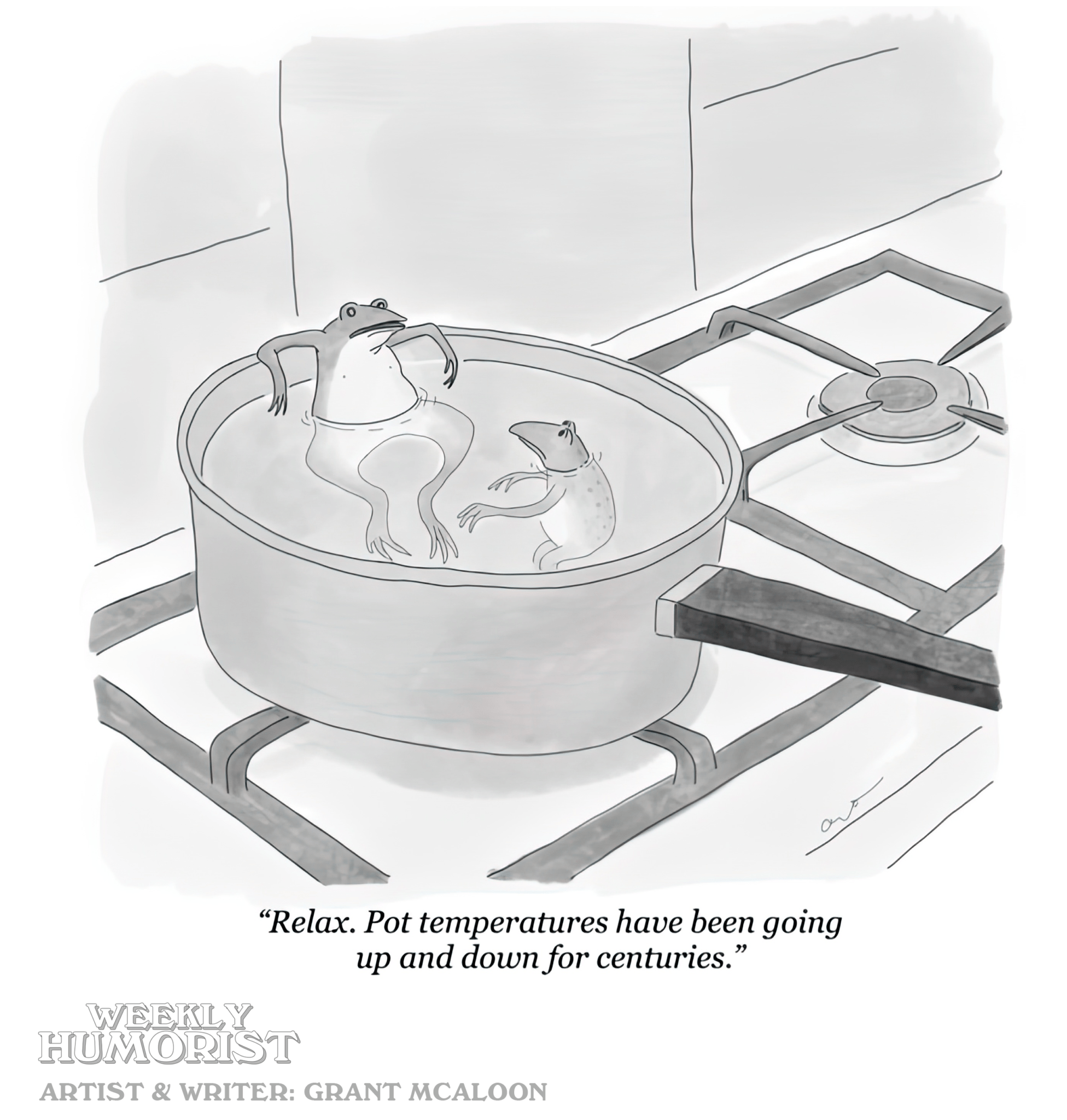
Frog in Pots Cartoon

Source: Weekly Humorist

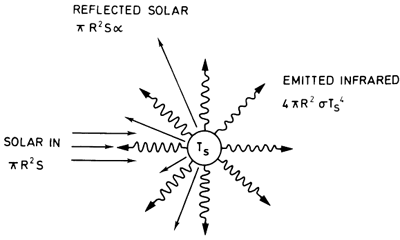
Planetary Energy Balance

Representation of Planetary Energy Balance

Source: Reprinted from A Climate Modeling Primer, A. Henderson-Sellers and K. McGuffie, Wiley, pg. 58, (1987) via https://www.e-education.psu.edu/meteo469/node/137.

Radiative Forcing

Climate changes result from changes to the energy balance of the planet (or radiative forcings), due to e.g.:

  • greenhouse gas emissions (which trap radiation, warming the planet);
  • aerosol emissions from air pollution or volcanic eruptions (which block incoming radiation, cooling the planet);
  • changes to the solar cycle (which can increase or decrease the incoming solar radiation).

Historical Radiative Forcing

Code
# Dataset from https://zenodo.org/record/3973015
# The CSV is read into a DataFrame object, and we specify that it is comma delimited
forcings_all_85 = CSV.read("data/climate/ERF_ssp585_1750-2500.csv", DataFrame, delim=",")

# Separate out the individual components
forcing_co2_85 = forcings_all_85[!,"co2"]
# Get total aerosol forcings
forcing_aerosol_rad_85 = forcings_all_85[!,"aerosol-radiation_interactions"]
forcing_aerosol_cloud_85 = forcings_all_85[!,"aerosol-cloud_interactions"]
forcing_aerosol_85 = forcing_aerosol_rad_85 + forcing_aerosol_cloud_85
forcing_total_85 = forcings_all_85[!,"total"]
forcing_non_aerosol_85 = forcing_total_85 - forcing_aerosol_85
forcing_other_85 = forcing_total_85 - (forcing_co2_85 + forcing_aerosol_85)

t = time_forcing = Int64.(forcings_all_85[!,"year"]) # Ensure that years are interpreted as integers

plot(xlabel="Year", ylabel="Radiative Forcing (W/m²)", tickfontsize=16, guidefontsize=18, legendfontsize=16, leftmargin=10mm, bottommargin=5mm, right_margin=5mm)
plot!(time_forcing, forcing_total_85, label="Total", color=:black, linewidth=3)
plot!(time_forcing, forcing_co2_85, label="CO₂", color=:orange, linewidth=2)
plot!(time_forcing, forcing_aerosol_85, label="Aerosol", color=:blue, linewidth=2)
plot!(time_forcing, forcing_other_85, label="Other", color=:purple, linewidth=2)
plot!(size=(800, 450))
xlims!((1750, 2020))
ylims!(-4.5, 5)
1750 1800 1850 1900 1950 2000 Year −4 −2 0 2 4 Radiative Forcing (W/m²) Total CO₂ Aerosol Other
Figure 2: Historical and projected radiative forcings.

What Are Some Sources of Relevant Uncertainty in Understanding Past and Future Climate Changes and Impacts?

One key question: what is the sensitivity of warming to continued CO2 emissions?

The Energy Balance Model (EBM)

\[\begin{align*} \overbrace{\frac{dH}{dt}}^{\text{change in heat}} &= \overbrace{F}^{\text{RF}} - \overbrace{\lambda T}^{\substack{\text{change in} \\ \text{temperature}}} \\[1em] \Rightarrow C\frac{dT}{dt} &= F - \lambda T - \gamma(T-T_D)\\ C_D\frac{dT_D}{dt} &= \gamma(T-T_D) \end{align*}\]

Two Layer EBM Schematic

Source: Palmer et al. (2018)

The EBM (cont’d)

  • \(c = 4.184\times 10^6 \\ \text{J/K/m}^2\) is the specific heat of water per area.
  • Total RF: \[F = F_\text{non-aerosol} + \alpha F_\text{aerosol}.\]
  • The climate feedback factor \(\lambda\) controls how much the Earth warms in response to radiative forcing.

EBM Discretization

Use Euler discretization:

\[\begin{align*} T(t+1) &= T(t) + \frac{F(t) - \lambda T(t) - \gamma(T(t) - T_D(d))}{C} \Delta t \\[0.5em] T_D(t+1) &= T_D(t) + \frac{\gamma (T(t) - T_D(t))}{C_D} \Delta t \end{align*}\]

Equilibrium Climate Sensitivity (ECS)

Under steady-state conditions (constant \(F\) and \(dT/dt = 0\)), \[T = \frac{F}{\lambda}.\]

When we double atmospheric CO2, we refer to the equilibrium temperature \(S\) as the equilibrium climate sensitivity:

\[S = \underbrace{F_{2\times \text{CO}_2}}_{\approx 4 \text{W/m}^2}/\lambda\]

Model Fitting

Degree of Freedom / Free Parameters

There are a few uncertain parameters:

  • \(\lambda\) or \(S\)
  • \(\gamma\) (deep ocean temp diffusion)
  • \(\alpha\) (aerosol scaling factor)
  • \(d\) (upper ocean mixing depth)
  • \(D\) (deep ocean mixing depth)
  • \(T_0\) (initial temperature in 1850)

Programming Implementation

function ebm(rf_nonaerosol, rf_aerosol; p=(3.2, 1.0, 1.3, 100.0, 800.0, -0.1))
    # set up model parameters
    S, γ, α, d, D, T₀ = p # this unpacks the parameter tuple into variables
    F2xCO₂ = 4.0 # radiative forcing [W/m²] for a doubling of CO₂
    λ = F2xCO₂ / S

    c = 4.184e6 # heat capacity/area [J/K/m²]
    C = c*d # heat capacity of mixed layer (per area)
    CD = c*D # heat capacity of deep layer (per area)
    F = rf_nonaerosol + α*rf_aerosol # radiative forcing
    Δt = 31558152. # annual timestep [s]

    T = zero(F)
    T[1] = T₀
    TD = zero(F)
    for i in 1:length(F)-1
        T[i+1] = T[i] + (F[i] - λ*T[i] - γ*(T[i]-TD[i]))/C * Δt
        TD[i+1] = TD[i] + γ*(T[i]-TD[i])/CD * Δt
    end
    # return after normalizing to reference period
    return T
end

ebm_wrap(params) = ebm(forcing_non_aerosol_85[hind_idx], forcing_aerosol_85[hind_idx], p = params)

Probability Models for Simulations

Computer Model: \[\eta(\underbrace{\theta}_{\substack{\text{calibration}\\\text{variables}}}; \underbrace{x}_{\substack{\text{control}\\\text{variables}}})\]

Observations: \[\mathbf{y} \sim p(\underbrace{\zeta(\mathbf{x})}_{\substack{\text{expected}\\\text{state}}})\]

Model-Data Discrepancy

Write \[\zeta(\mathbf{x}) = \delta(\eta(\theta; x))\] where \(\delta\) represents the discrepancy between the model output and the expected state.

Then the probability model is: \[\mathbf{y} \sim p(\delta(\eta(\theta; x))).\]

Model-Data Discrepancy

For example, \(\delta\) might capture:

  • Bias (e.g.: model consistently over/underpredicts);
  • Accumulations of error (e.g.: persistent model underestimates);
  • Partial observations (e.g.: do you count every animal?)

Probability Models for Simulation Models

Most common setting (e.g. Brynjarsdóttir & O’Hagan (2014)):

\[\mathbf{y} = \underbrace{\eta(\mathbf{x}; \theta)}_{\text{model}} + \underbrace{\delta(x)}_{\text{discrepancy}} + \underbrace{\varepsilon}_{\text{error}}\]

Discrepancy for the EBM Calibration

Assuming Gaussian Discrepancy

\[ \begin{align*} \mathbf{y} &= \eta(\mathbf{x}; \theta) + \delta(x) + \varepsilon \\ \delta &\sim N(0, \sigma^2) \\ \varepsilon &\sim N(0, \omega^2) \end{align*} \]

where \(\omega\) is the standard error of the data.

MLE for Gaussian Discrepancy

function gaussian_iid_homosked(params, temp_dat, temp_err, m)
    S, γ, α, d, D, T₀, σ = params 
    ebm_sim = m((S, γ, α, d, D, T₀))
    ll = sum(logpdf.(Normal.(ebm_sim, sqrt.(σ^2 .+ temp_err.^2)), temp_dat))
    return ll
end

lower = [1.0, 0.5, 0.0, 50.0, 200.0, temp_lo[1], 0.0]
upper = [5.0, 1.5, 2.0, 200.0, 1000.0, temp_hi[1], 10.0]
p0 = [3.0, 1.0, 1.0, 100.0, 800.0,temp_obs[1], 5.0]

result = Optim.optimize(params -> -gaussian_iid_homosked(params, temp_obs, temp_sd, ebm_wrap), lower, upper, p0)
θ_iid = result.minimizer

MLE for Gaussian Discrepancy

Parameters MLE
S 3.4
γ 1.5
α 0.9
d 77.1
D 627.6
T₀ -0.1
σ 0.1
Code
n_samples = 10_000
temp_iid = ebm_wrap(θ_iid) # simulate IID best fit
# simulate projections with discrepancy and errors
temp_iid_proj = zeros(n_samples, length(temp_sd))
for i = 1:length(temp_sd)
    temp_iid_err = rand(Normal(0, sqrt.(θ_iid[end]^2 .+ temp_sd[i]^2)), n_samples)
    temp_iid_proj[:, i] = temp_iid[i] .+ temp_iid_err
end
# calculate quantiles
temp_iid_q = mapslices(col -> quantile(col, [0.05, 0.5, 0.95]), temp_iid_proj; dims=1)

p = scatter(time_obs, temp_obs, color=:black, label="Observations", ylabel="(°C)", xlabel="Year", title="Temperature Anomaly")
plot!(p, time_obs, temp_iid_q[2, :], ribbon=(temp_iid_q[2, :] - temp_iid_q[1, :], temp_iid_q[3, :] - temp_iid_q[2, :]), color=:red, fillalpha=0.3, label="Gaussian Discrepancy")
plot!(size=(600, 500))
1850 1900 1950 2000 Year −0.5 0.0 0.5 1.0 1.5 (°C) Temperature Anomaly Observations Gaussian Discrepancy
Figure 3: MLE Fit for Gaussian discrepancy

Diagnosing Residuals

Code
resids_homogauss = temp_obs - temp_iid
p1 = plot(time_obs, resids_homogauss, linewidth=3, label=false, size=(600, 500), xlabel="Year", ylabel="Residual (°C)")
p2 = histogram(resids_homogauss, size=(600, 500), xlabel="Residual (°C)", ylabel="Count")

display(p1)
display(p2)
1850 1900 1950 2000 Year −0.3 −0.2 −0.1 0.0 0.1 0.2 Residual (°C)
(a) Residuals
−0.3 −0.2 −0.1 0.0 0.1 0.2 0.3 Residual (°C) 0 10 20 30 Count
(b)
Figure 4

Analyzing Residual Assumptions

Code
p1 = qqnorm(resids_homogauss, xlabel="Theoretical Values", ylabel="Empirical Values", title="Normal Q-Q Plot", size=(600, 500))
pacf_homogauss = pacf(resids_homogauss, 1:5)
p2 = plot(1:5, pacf_homogauss, marker=:circle, line=:stem, linewidth=3, markersize=8, tickfontsize=16, guidefontsize=18, legend=false, ylabel="Partial Autocorrelation", xlabel="Time Lag", title="Partial Autocorrelation Plot", size=(600, 500))
hline!(p2, [0], color=:black, linestyle=:dash)

display(p1)
display(p2)
−0.4 −0.2 0.0 0.2 Theoretical Values −0.4 −0.2 0.0 0.2 Empirical Values Normal Q-Q Plot
(a) Residual diagnostics
1 2 3 4 5 Time Lag 0.0 0.1 0.2 0.3 0.4 0.5 Partial Autocorrelation Partial Autocorrelation Plot
(b)
Figure 5

Key Points

Key Points

  • Probability models for simulation models involve
    • Discrepancy
    • Observation error
  • Most common: additive
  • “System state”: Model output + discrepancy
  • Check residual assumptions!

Key Points

  • Hindcast: compare observations with full output (discrepancy + error)
  • Projections: no error, just discrepancy (state estimates)

Discussion of Shmueli (2010)

Questions To Seed Discussion

  • What do you think are the differences between predictive and explanatory modeling?
  • What can go wrong when we conflate the two?
  • Can you think of approaches or workflows which bridge the two paradigms?

Upcoming Schedule

Next Classes

Wednesday: Correlates residuals and more general structures

Assessments

Homework 2 available; due next Friday (2/21).

References

References (Scroll for Full List)

Brynjarsdóttir, J., & O’Hagan, A. (2014). Learning about physical parameters: the importance of model discrepancy. Inverse Problems, 30, 114007. https://doi.org/10.1088/0266-5611/30/11/114007
Palmer, M. D., Harris, G. R., & Gregory, J. M. (2018). Extending CMIP5 projections of global mean temperature change and sea level rise due to thermal expansion using a physically-based emulator. Environ. Res. Lett., 13, 084003. https://doi.org/10.1088/1748-9326/aad2e4