Monte Carlo


Lecture 11

March 3, 2024

Review

Random Variable Generation

  • Quantile transform method turns uniforms into known distributions.
  • Rejection sampling can be used when quantiles are difficult to compute (but requires proposal covering target distribution).
  • Pseudorandom number generation and importance of seeds.

Monte Carlo Simulation

Stochastic Simulation

Goal: Estimate \(\mathbb{E}_p\left[h(x)\right]\), \(x \sim f(x)\)

Monte Carlo principle:

  • Sample \(x^1, x^2, \ldots, x^N \sim f(x)\)
  • Estimate \(\mathbb{E}_p\left[h(x)\right] \approx \sum_{n=1}^N h(x^n)\) / N

In other words: replace calculus with data summaries!

Monte Carlo Process Schematic

G a Probability Distribution b Random Samples a->b Sample c Model b->c Input d Outputs c->d Simulate

Goals of Monte Carlo

Monte Carlo is a broad method, which can be used to:

  1. Obtain probability distributions of outputs;
  2. Estimate deterministic quantities (Monte Carlo estimation).

MC Example: Finding \(\pi\)

How can we use MC to estimate \(\pi\)?

Hint: Think of \(\pi\) as an expected value…

MC Example: Finding \(\pi\)

Finding \(\pi\) by sampling random values from the unit square and computing the fraction in the unit circle. This is an example of Monte Carlo integration.

\[\frac{\text{Area of Circle}}{\text{Area of Square}} = \frac{\pi}{4}\]

Code
Logging.disable_logging(Logging.Info)

function circleShape(r)
    θ = LinRange(0, 2 * π, 500)
    r * sin.(θ), r * cos.(θ)
end

nsamp = 3000
unif = Uniform(-1, 1)
x = rand(unif, (nsamp, 2))
l = mapslices(v -> sum(v.^2), x, dims=2)
in_circ = l .< 1
pi_est = [4 * mean(in_circ[1:i]) for i in 1:nsamp]

plt1 = plot(
    1,
    xlim = (-1, 1),
    ylim = (-1, 1),
    legend = false,
    markersize = 4,
    framestyle = :origin,
    tickfontsize=16,
    grid=:false
    )
plt2 = plot(
    1,
    xlim = (1, nsamp),
    ylim = (3, 3.5),
    legend = :false,
    linewidth=3, 
    color=:black,
    tickfontsize=16,
    guidefontsize=16,
    xlabel="Iteration",
    ylabel="Estimate",
    right_margin=5mm
)
hline!(plt2, [π], color=:red, linestyle=:dash)
plt = plot(plt1, plt2, layout=Plots.grid(2, 1, heights=[2/3, 1/3]), size=(600, 500))

plot!(plt, circleShape(1), linecolor=:blue, lw=1, aspectratio=1, subplot=1)


mc_anim = @animate for i = 1:nsamp
    if l[i] < 1
        scatter!(plt[1], Tuple(x[i, :]), color=:blue, markershape=:x, subplot=1)
    else
        scatter!(plt[1], Tuple(x[i, :]), color=:red, markershape=:x, subplot=1)
    end
    push!(plt, 2, i, pi_est[i])
end every 100

gif(mc_anim, "figures/mc_pi.gif", fps=3)
Figure 1: MCMC Estimation of pi

MC Example: Dice

What is the probability of rolling 4 dice for a total of 19?

Can simulate dice rolls and find the frequency of 19s among the samples.

Code
function dice_roll_repeated(n_trials, n_dice)
    dice_dist = DiscreteUniform(1, 6) 
    roll_results = zeros(n_trials)
    for i=1:n_trials
        roll_results[i] = sum(rand(dice_dist, n_dice))
    end
    return roll_results
end

nsamp = 10000
# roll four dice 10000 times
rolls = dice_roll_repeated(nsamp, 4) 

# calculate probability of 19
sum(rolls .== 19) / length(rolls)

# initialize storage for frequencies by sample length
avg_freq = zeros(length(rolls)) 
std_freq = zeros(length(rolls)) 

# compute average frequencies of 19
avg_freq[1] = (rolls[1] == 19)
count = 1
for i=2:length(rolls)
    avg_freq[i] = (avg_freq[i-1] * (i-1) + (rolls[i] == 19)) / i
    std_freq[i] = 1/sqrt(i-1) * std(rolls[1:i] .== 19)
end

plt = plot(
    1,
    xlim = (1, nsamp),
    ylim = (0, 0.1),
    legend = :false,
    tickfontsize=16,
    guidefontsize=16,
    xlabel="Iteration",
    ylabel="Estimate",
    right_margin=8mm,
    color=:black,
    linewidth=3,
    size=(600, 400)
)
hline!(plt, [0.0432], color="red", 
    linestyle=:dash) 

mc_anim = @animate for i = 1:nsamp
    push!(plt, 1, i, avg_freq[i])
end every 100

gif(mc_anim, "figures/mc_dice.gif", fps=10)
Figure 2: MCMC Estimation of pi

Monte Carlo and Uncertainty Propagation

Monte Carlo simulation: propagate uncertainties from inputs through a model to outputs.

This is an example of uncertainty propagation: draw samples from some distribution, and run them through one or more models to find the (conditional) probability of outcomes of interest (for good or bad).

Why Monte Carlo Works

Monte Carlo: Formal Approach

Formally: Monte Carlo estimation as the computation of the expected value of a random quantity \(Y = f(X)\), \(\mu = \mathbb{E}[Y]\).

To do this, generate \(n\) independent and identically distributed values \(Y_1, \ldots, Y_n\). Then the sample estimate is

\[\tilde{\mu}_n = \frac{1}{n}\sum_{i=1}^n Y_i\]

What Makes a Good Statistical Estimator?

Statistical estimators are random, which means we can’t ever guarantee that we get back the “true” value

  • No bias (\(\text{Bias} = \mathbb{E}_g[\tilde{\mu}] - \mu\))
  • Well-characterized, ideally small, variance (\(\text{Var}(\tilde{\mu})\))

The Law of Large Numbers

If

  1. \(Y\) is a random variable and its expectation exists and

  2. \(Y_1, \ldots, Y_n\) are independently and identically distributed

Then by the weak law of large numbers:

\[\lim_{n \to \infty} \mathbb{P}\left(\left|\tilde{\mu}_n - \mu\right| \leq \varepsilon \right) = 1\]

The Law of Large Numbers

In other words, eventually Monte Carlo estimates will get within an arbitrary error of the true expectation.

But how large is large enough?

Monte Carlo Sample Mean

The sample mean \(\tilde{\mu}_n = \frac{1}{n}\sum_{i=1}^n Y_i\) is itself a random variable.

With some assumptions (the mean of \(Y\) exists and \(Y\) has finite variance), the expected Monte Carlo sample mean \(\mathbb{E}[\tilde{\mu}_n]\) is

\[\frac{1}{n}\sum_{i=1}^n \mathbb{E}[Y_i] = \frac{1}{n} n \mu = \mu\]

Monte Carlo Error

We’d like to know more about the error of this estimate for a given sample size. The variance of this estimator is

\[\tilde{\sigma}_n^2 = \text{Var}\left(\tilde{\mu}_n\right) = \mathbb{E}\left((\tilde{\mu}_n - \mu)^2\right) = \frac{\sigma_Y^2}{n}\]

So as \(n\) increases, the standard error decreases:

\[\tilde{\sigma}_n = \frac{\sigma_Y}{\sqrt{n}}\]

Monte Carlo Error

In other words, if we want to decrease the Monte Carlo error by 10x, we need 100x additional samples. This is not an ideal method for high levels of accuracy.

Monte Carlo is an extremely bad method. It should only be used when all alternative methods are worse.

— Sokal, Monte Carlo Methods in Statistical Mechanics, 1996

But…often most alternatives are worse!

When Might We Want to Use Monte Carlo?

If you can compute your integrals analytically or through quadrature, you probably should.

But for many “real” problems, this is either

  1. Not possible (or computationally intractable);
  2. Requires a lot of stylization and simplification.

Monte Carlo Confidence Intervals

Basic Idea: The Central Limit Theorem says that with enough samples, the errors are normally distributed:

\[\left\|\tilde{\mu}_n - \mu\right\| \to \mathcal{N}\left(0, \frac{\sigma_Y^2}{n}\right)\]

Monte Carlo Confidence Intervals

The \(\alpha\)-confidence interval is: \[\tilde{\mu}_n \pm \Phi^{-1}\left(1 - \frac{\alpha}{2}\right) \frac{\sigma_Y}{\sqrt{n}}\]

For example, the 95% confidence interval is \[\tilde{\mu}_n \pm 1.96 \frac{\sigma_Y}{\sqrt{n}}.\]

Implications of Monte Carlo Error

Converging at a rate of \(1/\sqrt{n}\) is not great. But:

  • All models are wrong, and so there always exists some irreducible model error.
  • We often need a lot of simulations. Do we have enough computational power?

Monte Carlo Example

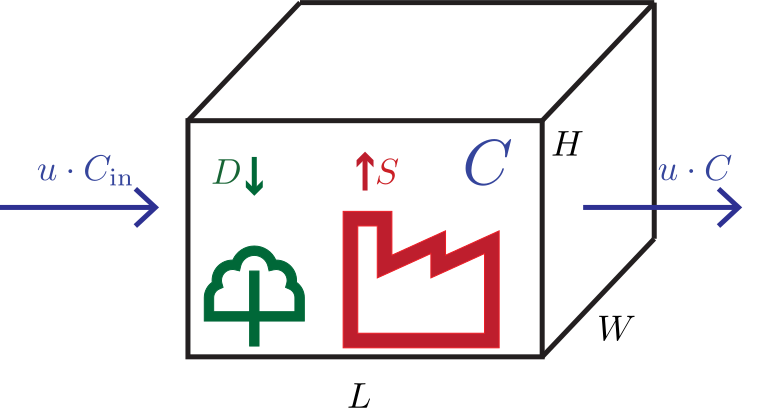
Airshed Model

Figure 3: Illustration of the airshed, including notation.

Goal: Find the probability of exceeding the 1-hour SO2 average exposure concentration standard, which is 0.14 ppm.

\[\mathbb{P}[\text{SO}_2(\theta) > 0.14] = \int \mathbb{I}(\text{SO}_2(\theta) > 0.14) p(\theta) d\theta\]

Airshed Model

Figure 4: Illustration of the airshed, including notation.

\[\frac{dC}{dt} = \frac{u}{L} C_\text{in} + \frac{S-D}{WHL} - \left(\frac{u}{L} + k\right)C\]

Forward Euler Discretization

\[ \frac{dC}{dt} = \frac{u}{L} C_\text{in}(t) + \frac{S-D}{WHL} - \left(\frac{u}{L} + k\right)C\]

\[\Rightarrow \frac{C(t+1) - C(t)}{\Delta t} = \frac{u}{L} C_\text{in}(t) + \frac{R}{WHL} - \left(\frac{u}{L} + k\right)C(t)\]

\[\bbox[yellow, 10px, border:5px solid red]{C(t+1) = \left(1 - \Delta t\left(\frac{u}{L} + k\right)\right)C(t) + \Delta t \left(\frac{u}{L} C_\text{in}(t) + \frac{R}{WHL}\right)} \]

Monte Carlo Samples

Code
nsamp = 1000
u = rand(LogNormal(log(2), 1), nsamp)
Cin = rand(LogNormal(log(0.16), 0.12), nsamp)
R = rand(Normal(0.5, 0.5), nsamp)

p1 = histogram(u, ylabel="count", xlabel=L"$u$ (m/s)", label=false, tickfontsize=16, guidefontsize=18, size=(400, 450))
p2 = histogram(Cin, ylabel="count", xlabel=L"$C_{in}$ (ppm)", label=false, tickfontsize=16, guidefontsize=18, size=(400, 450))
p3 = histogram(R, ylabel="count", xlabel=L"$R$ (ppm/hr)", label=false, tickfontsize=16, guidefontsize=18, size=(400, 450))
display(p1)
display(p2)
display(p3)
(a) Monte Carlo samples for the airshed model.
(b)
(c)
Figure 5

Simulation Results

Code
# other parameters
C₀ = 0.07
T = 60
k = 0.3
W = 4
H = 5
L = 4
# conduct simulation
P = u / L .* Cin
l = u / L .+ k
C2 = zeros(T*100 + 1, nsamp)
S = 0:0.01:T
for (i, t) in pairs(S)
    if i == 1
        C2[i, :] .= C₀
    else
        C2[i, :] = (1 .- 0.01*l) .* C2[i-1, :] .+ 0.01 * P .+ 0.01 * R / (H * W * L)
    end
end
mean_SO2 = map(mean, eachcol(C2)) # calculate means
# plot histogram
p1 = histogram(mean_SO2, xlabel="1-Hour Average Exposure (ppm)", ylabel="Count", legend=false, tickfontsize=16, guidefontsize=18)
vline!(p1, [0.14], color=:red, linestyle=:dash, linewidth=3)
xticks!(p1, 0:0.04:0.3)
xaxis!(p1, xminorticks=2)
plot!(p1, size=(600, 450))
# plot cdf
p2 = plot(sort(mean_SO2), (1:nsamp) ./ nsamp, xlabel="1-Hour Average Exposure (ppm)", ylabel="Cumulative Probability", legend=false, tickfontsize=17, guidefontsize=18, linewidth=3)
vline!(p2, [0.14], linestyle=:dash, color=:red, linewidth=3, minorgrid=true)
xticks!(p2, 0:0.04:0.3)
xaxis!(p2, xminorticks=2)
yaxis!(p2, yminorticks=5)
plot!(p2, size=(600, 450))

display(p1)
display(p2)
(a) Monte Carlo samples for the airshed model.
(b)
Figure 6

Monte Carlo Estimation

\[\hat{\mu}_n = \frac{1}{n}\sum_{i=1}^n \mathbb{I}[x_i > 0.14]\]

\[\hat{\sigma}_n = \sqrt{\frac{\text{Var}(\mathbb{I}[x_{1:n} > 0.14])}{n}}\]

Code
# show Monte Carlo estimate stabilization
avg_mc_out = zeros(nsamp)
avg_mc_out[1] = mean_SO2[1] > 0.14
std_mc_out = zeros(nsamp)
std_mc_out[1] = 0
for i = 2:nsamp
    avg_mc_out[i] = (avg_mc_out[i-1] * (i-1) + (mean_SO2[i] > 0.14)) / i
    std_mc_out[i] = 1/sqrt(i) * std(mean_SO2[1:i] .> 0.14)
end
p = plot(avg_mc_out, xlabel="Monte Carlo Iteration", ylabel="Probability", left_margin=3mm, legend=:false, ribbon=1.96*std_mc_out, fillalpha=0.3, linewidth=2, tickfontsize=16, guidefontsize=18, fillcolor=:red, right_margin=5mm, minorgrid=true)
ylims!(p, (0, 0.3))
yaxis!(p, yminorticks=5)
plot!(p, size=(600, 450))
display(p)
Figure 7: Monte Carlo estimation for the airshed model.

Monte Carlo Optimization

Can also use Monte Carlo to estimate expected values for optimization problems

For example: in previous problem, might try to optimize a control strategy with an objective of minimizing violations. But no closed form representation of the distribution, so use MC.

Estimating Quantiles with Monte Carlo

MC Estimate of the CDF

Would like to estimate the CDF \(F\) with some approximation \(\hat{F}_n\), then compute \(\hat{z}^\alpha_n = \hat{F}_n^{-1}(\alpha)\) as an estimator of the \(\alpha\)-quantile \(z^\alpha\).

Given samples \(\hat{\mathbf{y}} = y_1, \ldots, y_n \sim F\), define \[\hat{F}_(y) = \frac{1}{n} \sum_{i=1}^n \mathbb{I}(y_i \leq y).\]

Is This An Unbiased Estimator?

\[ \begin{align*} \mathbb{E}[\hat{F}_(y)] &= \frac{1}{n} \sum_{i=1}^n \mathbb{I}(y_i \leq y) \\ &= \frac{1}{n} \sum_{i=1}^n \mathbb{P}(y_i \leq y) \\ &= F(y) \end{align*} \]

Monte Carlo Quantile Estimation Error

From the CLT and some (not super important) theory about order statistics: \[\text{Var}(\hat{z}^\alpha_n) \to \frac{\sigma^2_y}{n}\frac{\alpha (1 - \alpha)}{f^2(z^\alpha)}\]

In other words, the smaller the density at the “true” quantile \(z^\alpha\), the greater the error.

More Advanced Monte Carlo Methods (Teasers)

What If We Can’t Sample From The Distribution?

  • May not be able to generate samples \(X \sim f(x)\) efficiently
  • Think of sampling from tails:

\[P(X > k) \approx \frac{1}{M} \sum_{i=1}^M \mathbb{I}(X_i > k)\]

Importance Sampling

Extension of rejection sampling without requiring “rejection”:

  1. Draw samples from importance distribution g(x);
  2. Reweight samples: \[ \begin{align*} \mathbb{E}_f[h(x)] &= \int_x \frac{f(x)}{g(x)} g(x)h(x) dx \\ &\approx \frac{1}{M} \sum_{i=1}^M \frac{f(x)}{g(x)}h(x) \end{align*} \]

Importance Sampling Needs

Technically works with any proposal \(g\), but more efficient if \(g\) “covers” \(f\) (like with rejection sampling):

\[f(x)/g(x) < M < \infty\]

Antithetic Variates

If target values of pairs of samples \(h(X_i\)) and \(h(Y_i)\) are negatively correlated, can increase rate of convergence of \[\frac{1}{2M} \sum_{i=1}^M [h(X_i) + h(Y_i)]\] relative to \(\frac{1}{2M} h(X_i)\) alone.

Antithetic Variate Generation Can Be Difficult in Practice

  • Ensuring anti-correlation can be difficult to verify in general;
  • Gains in efficiency are dependent on effectiveness of antithetical variate generation and shape of \(h(x)\)

Key Points

Key Points

  • Monte Carlo: stochastic simulation instead of integration to estimate expected values
  • Monte Carlo is an unbiased estimator; confidence intervals given by CLT.
  • Be mindful of Monte Carlo standard error for “naive” MC with iid samples.
  • Advanced: Variance reduction techniques to improve convergence, see e.g. https://artowen.su.domains/mc/Ch-var-basic.pdf.

Perhaps Most Importantly…

Always report Monte Carlo error!

Upcoming Schedule

Next Classes

Wednesday: The Bootstrap

References

References (Scroll for Full List)