Uncertainty Quantification and The Bootstrap
Lecture 12
March 5, 2024
Review
Monte Carlo Simulation
- Monte Carlo Principle: Approximate \[\mathbb{E}_f[h(X)] = \int h(x) f(x) dx \approx \frac{1}{n} \sum_{i=1}^n h(X_i)\]
- Monte Carlo is an unbiased estimator, but beware (and always report) the standard error \(\sigma_n = \sigma_Y / \sqrt{n}\) or confidence intervals.
- More advanced methods can reduce variance, but may be difficult to implement in practice.
Uses of Monte Carlo
- Estimate expectations / quantiles;
- Calculate deterministic quantities (framed as stochastic expectations);
- Optimization (problem 3 on HW3).
Sampling Distributions
So Far…
We’re 7 weeks in and haven’t said anything about how to quantify uncertainties.
Let’s talk about that.
Sampling Distributions
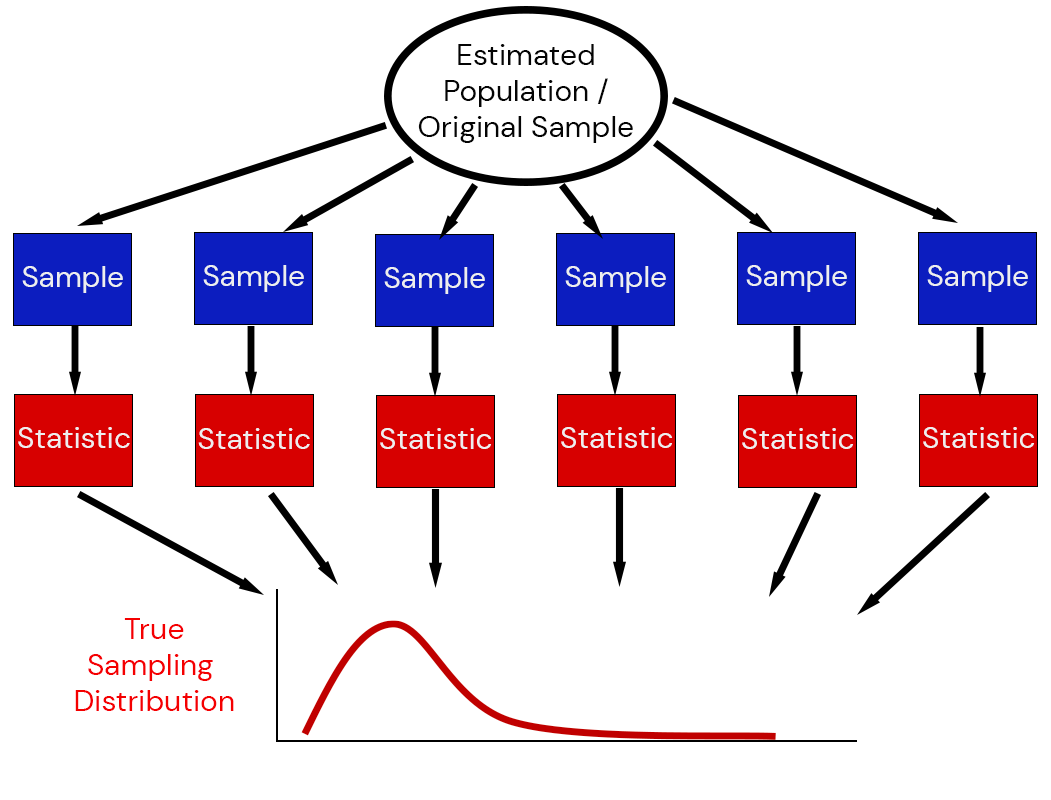
The sampling distribution of a statistic captures the uncertainty associated with random samples.
Estimating Sampling Distributions
- Special Cases: can derive closed-form representations of sampling distributions (think statistical tests)
- Asymptotics: Central Limit Theorem or Fisher Information
Fisher Information
Fisher Information: \[\mathcal{I}_x(\theta) = -\mathbb{E}\left[\frac{\partial^2}{\partial \theta_i \partial \theta_j} \log \mathcal{L}(\theta | x)\right]\]
Observed Fisher Information (uses observed data and calculated at the MLE): \[\mathcal{I}_\tilde{x}(\hat{\theta})\]
Fisher Information and Standard Errors
Asymptotic result: \[\sqrt{n}(\theta_\text{MLE} - \theta^*) \to N(0, \left(\mathcal{I}_x(\hat{\theta^*})\right)^{-1}\]
Sampling distribution based on observed data: \[\theta \sim N\left(\hat{\theta}_\text{MLE}, \left(n\mathcal{I}_\tilde{x}(\theta_\text{MLE})\right)^{-1}\right)\]
Estimating Fisher Information
- Can be done with automatic differentiation or (sometimes hard) calculations;
- May be singular (no inverse ; undefined standard errors) for complex models;
- May not be a good approximation of the variance for finite samples!
The Bootstrap
The Bootstrap Principle
Efron (1979) suggested combining estimation with simulation: the bootstrap.
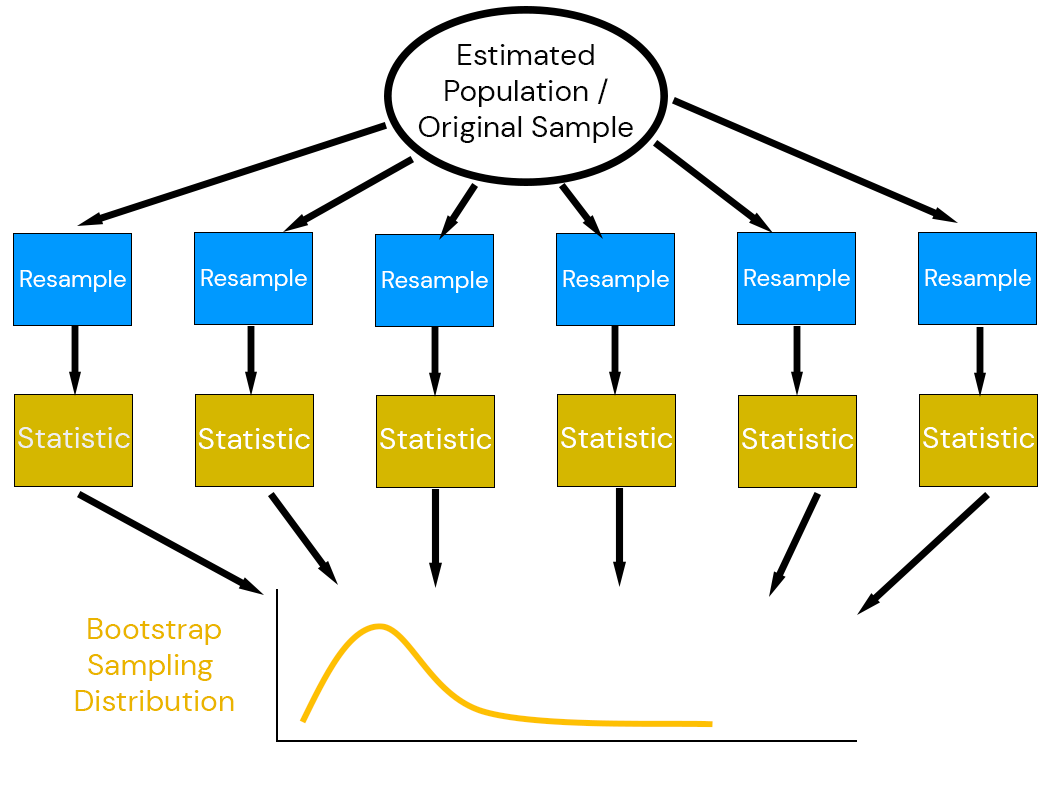
Key idea: use the data to simulate a data-generating mechanism.

Bootstrap Principle
- Assume the existing data is representative of the “true” population,
- Simulate based on properties of the data itself
- Re-estimate statistics from re-samples.
Why Does The Bootstrap Work?
Efron’s key insight: due to the Central Limit Theorem, the bootstrap distribution \(\mathcal{D}(\tilde{t}_i)\) has the same relationship to the observed estimate \(\hat{t}\) as the sampling distribution \(\mathcal{D}(\hat{t})\) has to the “true” value \(t_0\):
\[\mathcal{D}(\tilde{t} - \hat{t}) \approx \mathcal{D}(\hat{t} - t_0)\]
where \(t_0\) the “true” value of a statistic, \(\hat{t}\) the sample estimate, and \((\tilde{t}_i)\) the bootstrap estimates.
What Can We Do With The Bootstrap?
Let \(t_0\) the “true” value of a statistic, \(\hat{t}\) the estimate of the statistic from the sample, and \((\tilde{t}_i)\) the bootstrap estimates.
- Estimate Variance: \(\text{Var}[\hat{t}] \approx \text{Var}[\tilde{t}]\)
- Bias Correction: \(\mathbb{E}[\hat{t}] - t_0 \approx \mathbb{E}[\tilde{t}] - \hat{t}\)
Notice that bias correction “shifts” away from the bootstrapped samples.
“Simple” Bootstrap Confidence Intervals
- Basic Bootstrap CIs (based on CLT for error distribution \(\tilde{t} - \hat{t}\)): \[\left(\hat{t} - (Q_{\tilde{t}}(1-\alpha/2) - \hat{t}), \hat{t} - (Q_{\tilde{t}}(\alpha/2) - \hat{t})\right)\]
- Percentile Bootstrap CIs (simplest, often wrong coverage): \[(Q_{\tilde{t}}(1-\alpha/2), Q_{\tilde{t}}(1-\alpha/2))\]
The Non-Parametric Bootstrap
The Non-Parametric Bootstrap
The non-parametric bootstrap is the most “naive” approach to the bootstrap: resample-then-estimate.
Sources of Non-Parametric Bootstrap Error
- Sampling error: error from using finitely many replications
- Statistical error: error in the bootstrap sampling distribution approximation
Simple Example: Is A Coin Fair?
Suppose we have observed twenty flips with a coin, and want to know if it is weighted.
Code
1×20 adjoint(::Vector{Bool}) with eltype Bool:
 1  1  0  0  0  1  0  0  0  1  1  1  1  1  1  0  1  1  1  1
The frequency of heads is 0.65.
Is The Coin Fair?
Code
# bootstrap: draw new samples
function coin_boot_sample(dat)
    boot_sample = sample(dat, length(dat); replace=true)
    return boot_sample
end

function coin_boot_freq(dat, nsamp)
    boot_freq = [sum(coin_boot_sample(dat)) for _ in 1:nsamp]
    return boot_freq / length(dat)
end

boot_out = coin_boot_freq(dat, 1000)
q_boot = 2 * freq_dat .- quantile(boot_out, [0.975, 0.025])

p = histogram(boot_out, xlabel="Heads Frequency", ylabel="Count", title="1000 Bootstrap Samples", label=false, right_margin=5mm)
vline!(p, [p_true], linewidth=3, color=:orange, linestyle=:dash, label="True Probability")
vline!(p, [mean(boot_out) ], linewidth=3, color=:red, linestyle=:dash, label="Bootstrap Mean")
vline!(p, [freq_dat], linewidth=3, color=:purple, linestyle=:dot, label="Observed Frequency")
vspan!(p, q_boot, linecolor=:grey, fillcolor=:grey, alpha=0.3, fillalpha=0.3, label="95% CI")
plot!(p, size=(1000, 450))Larger Sample Example
Code
n_flips = 50
dat = rand(coin_dist, n_flips)
freq_dat = sum(dat) / length(dat)

boot_out = coin_boot_freq(dat, 1000)
q_boot = 2 * freq_dat .- quantile(boot_out, [0.975, 0.025])

p = histogram(boot_out, xlabel="Heads Frequency", ylabel="Count", title="1000 Bootstrap Samples", titlefontsize=20, guidefontsize=18, tickfontsize=16, legendfontsize=16, label=false, bottom_margin=7mm, left_margin=5mm, right_margin=5mm)
vline!(p, [p_true], linewidth=3, color=:orange, linestyle=:dash, label="True Probability")
vline!(p, [mean(boot_out) ], linewidth=3, color=:red, linestyle=:dash, label="Bootstrap Mean")
vline!(p, [freq_dat], linewidth=3, color=:purple, linestyle=:dot, label="Observed Frequency")
vspan!(p, q_boot, linecolor=:grey, fillcolor=:grey, alpha=0.3, fillalpha=0.3, label="95% CI")
plot!(p, size=(1000, 450))Why Use The Non-Parametric Bootstrap?
- Do not need to rely on variance asymptotics;
- Can obtain non-symmetric CIs.
- Embarrassingly parallel to simulate new replicates and generate statistics.
When Can’t You Use The Non-Parametric Bootstrap
- Maxima/minima
- Very extreme values.
Generally, anything very sensitive to outliers which might not be re-sampled.
Bootstrapping with Structured Data
The naive non-parametric bootstrap that we just saw doesn’t work if data has structure, e.g. spatial or temporal dependence.
Simple Bootstrapping Fails with Structured Data
Code
tide_dat = CSV.read(joinpath("data", "surge", "norfolk-hourly-surge-2015.csv"), DataFrame)
surge_resids = tide_dat[:, 5] - tide_dat[:, 3]

p1 = plot(surge_resids, xlabel="Hour", ylabel="(m)", title="Tide Gauge Residuals", label=:false, linewidth=3)
plot!(p1, size=(600, 450))

resample_index = sample(1:length(surge_resids), length(surge_resids); replace=true)
p2 = plot(surge_resids[resample_index], xlabel="Hour", ylabel="(m)", title="Tide Gauge Resample", label=:false, linewidth=3)
plot!(p2, size=(600, 450))

display(p1)
display(p2)Block Bootstraps
Clever idea from Kunsch (1989): Divide time series \(y_{1:T}\) into overlapping blocks of length \(k\).
\[\{y_{1:k}, y_{2:k+1}, \ldots y_{n-k+1:n}\}\]
Then draw \(m = n / k\) of these blocks with replacement and construct replicate time series:
\[\hat{y}_{1:n} = (y_{b_1}, \ldots, y_{b_m}) \]
Note: Your series must not have a trend!
Block Bootstrap Example
Code
20×5 Matrix{Float64}:
  0.136   0.107   0.097   0.093   0.093
  0.107   0.097   0.093   0.093   0.08
  0.097   0.093   0.093   0.08    0.068
  0.093   0.093   0.08    0.068   0.031
  0.093   0.08    0.068   0.031   0.005
  0.08    0.068   0.031   0.005   0.011
  0.068   0.031   0.005   0.011   0.012
  0.031   0.005   0.011   0.012   0.001
  0.005   0.011   0.012   0.001  -0.002
  0.011   0.012   0.001  -0.002  -0.014
  0.012   0.001  -0.002  -0.014  -0.013
  0.001  -0.002  -0.014  -0.013  -0.015
 -0.002  -0.014  -0.013  -0.015  -0.02
 -0.014  -0.013  -0.015  -0.02   -0.019
 -0.013  -0.015  -0.02   -0.019  -0.031
 -0.015  -0.02   -0.019  -0.031  -0.071
 -0.02   -0.019  -0.031  -0.071  -0.067
 -0.019  -0.031  -0.071  -0.067  -0.084
 -0.031  -0.071  -0.067  -0.084  -0.086
 -0.071  -0.067  -0.084  -0.086  -0.092
Code
m = Int64(ceil(length(surge_resids) / k))
n_boot = 1_000
surge_bootstrap = zeros(length(surge_resids), n_boot)
for i = 1:n_boot
    block_sample_idx = sample(1:n_blocks, m; replace=true)
    surge_bootstrap[:, i] = reduce(vcat, blocks[:, block_sample_idx])
end

p = plot(surge_resids, color=:black, lw=3, label="Data", xlabel="Hour", ylabel="(m)", title="Tide Gauge Residuals", alpha=0.5)
plot!(p, surge_bootstrap[:, 1], color=:blue, lw=3, label="Replicate", alpha=0.5)
plot!(p, size=(600, 500))Block Bootstrap Replicates
Code
Generalizing the Block Bootstrap
- Circular Bootstrap: “Wrap” the time series in a circle, \(y_1, y_2, \ldots, y_n, y_1, y_2, \ldots\) then divide into blocks and resample.
- Stationary Bootstrap: Use random block lengths to avoid systematic boundary transitions.
- Block of Blocks Bootstrap: Divide series into blocks of length \(k_2\), then subdivide into blocks of length \(k_1\). Sample blocks with replacement then sample sub-blocks within each block with replacement.
Key Points and Upcoming Schedule
Key Points
- Bootstrap: Approximate sampling distribution by re-simulating data
- Non-Parametric Bootstrap: Treat data as representative of population and re-sample.
- More complicated for structured data: block bootstrap for time series, analogues for spatial data.
Sources of Non-Parametric Bootstrap Error
- Sampling error: error from using finitely many replications
- Statistical error: error in the bootstrap sampling distribution approximation
When To Use The Non-Parametric Bootstrap
- Sample is representative of the sampling distribution
- Doesn’t work well for extreme values!
- Does not work at all for max/mins (or any other case where the CLT fails).
Next Classes
Monday: The Parametric Bootstrap
Wednesday: What is a Markov Chain?
Assessments
Homework 3: Due next Friday (3/14)
Project Proposals: Due 3/21.
References
References (Scroll for Full List)
Efron, B. (1979). Bootstrap methods: Another look at the jackknife. Ann. Stat., 7, 1–26. https://doi.org/10.1214/aos/1176344552
Kunsch, H. R. (1989). The jackknife and the bootstrap for general stationary observations. Ann. Stat., 17, 1217–1241. https://doi.org/10.1214/aos/1176347265